




Ancient Pottery Reveals Insight into Early Mathematical Thinking: Evidence from Northern Mesopotamia
A fascinating study from two archaeologists at the Hebrew University of Jerusalem uncovers what might be the earliest known evidence of mathematical thought among human societies, inscribed in the decorative patterns of pottery dating back almost 8,000 years. This groundbreaking research highlights the cultural and intellectual advancements of the Halafian civilization, which thrived in northern Mesopotamia between 6200 and 5500 B.C.
A Dive into the Research
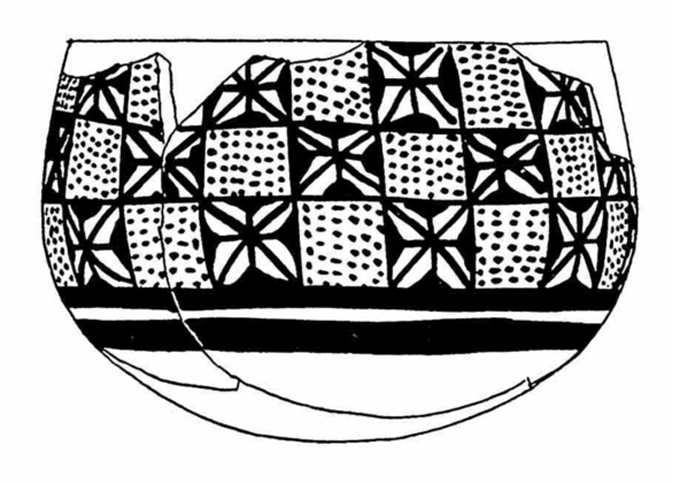
The study, published in the Journal of World Prehistory, meticulously catalogs the plant motifs found on pottery fragments unearthed at archaeological sites since the 1930s. Among these designs, the researchers—Yosef Garfinkel and Sarah Krulwich—focused specifically on floral decorations, revealing a striking mathematical pattern.
The flowers depicted on this ancient pottery often feature four, eight, 16, 32, or 64 petals, numbers that follow a geometric progression linked to powers of two. Garfinkel asserts that such consistent patterns suggest a sophisticated understanding of mathematics for that era—potentially utilized by the Halafians in agriculture for dividing land and produce.
Garfinkel explains, “[These numbers] indicate that the Halafians possessed advanced knowledge of this type of mathematics. This understanding may have been developed for dividing land or crops into equal shares."
Breaking Down the Significance
This research not only sheds light on the Halafians' artistic expression but also offers insights into their daily life and intellectual capabilities. The findings exemplify how early cultures were not only developing practical skills but were also engaging in abstract thinking.
Unlike the later Sumerians, who developed a base-60, or sexagesimal numerical system more than 1,500 years later, the Halafians’ numeric understanding predates this by a significant margin. Their mathematical framework operated on a more fundamental principle: doubling numbers, which may have been simply more functional for their needs at the time.
Garfinkel emphasizes the profound implications of these findings: “What we have here is an earlier mathematical system before the sexagesimal system took hold… This is evidence of mathematical knowledge that we are not aware of from any other source.”
The Broader Implications
This research not only marks an important milestone in understanding ancient mathematics but also enriches our comprehension of the evolution of human thought. The presence of mathematical concepts within artistic expressions provides a unique lens into how early societies may have operated, structured their environments, and interacted with each other.
The beautiful motifs carved into Halafian pottery serve not only as decorative elements but also as markers of a complex cognitive landscape that includes agricultural practices, social organization, and the foundations of mathematical reasoning. This connection between art and mathematics underscores the inherently multidisciplinary nature of human development.
Looking Ahead
As excavation efforts continue in northern Mesopotamia, further studies could yield additional artifacts that deepen our understanding of early human civilization. This significant breakthrough invites future researchers to reassess previously accepted timelines and frameworks regarding the emergence of complex cognitive skills in ancient societies.
For those interested in delving deeper into the world of archaeology, more stories can be found on related topics such as Neandertal fire-making tools and ancient rock art here.
As we continue to uncover the layers of our past, it becomes increasingly clear that the seeds of modern civilization were being planted long before recorded history commenced—a testament to human creativity and intellectual evolution.