




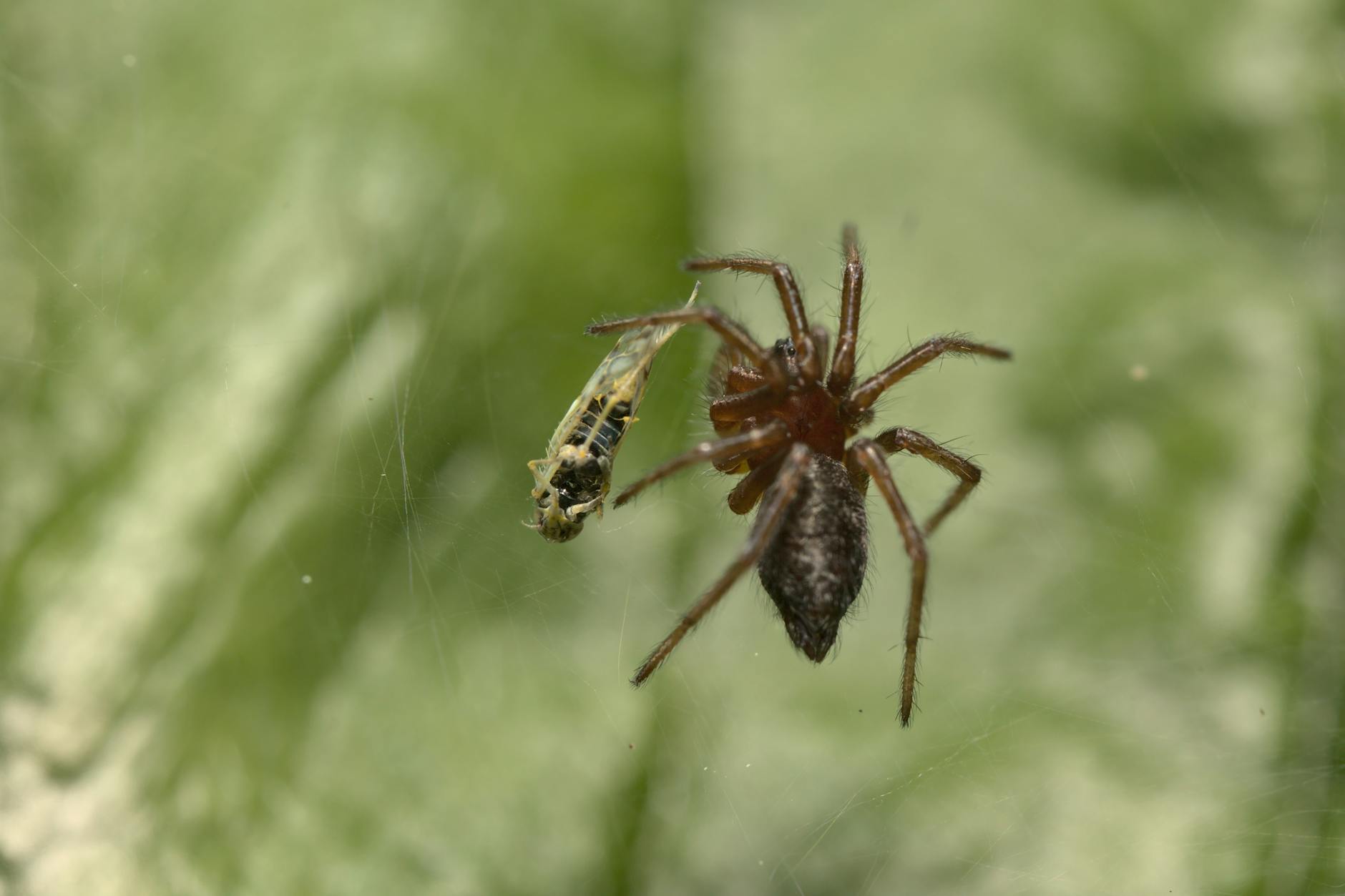
Ingenious Silk: How Net-Casting Spiders Use Sophisticated Webbing to Catch Prey
In the ever-fascinating world of spiders, the net-casting spider, specifically the rufous net-casting spider (Asianopis subrufa), has recently captured the attention of researchers for its remarkable web-slinging abilities. These intriguing arachnids exhibit both strength and elasticity in their web design, making their approach to hunting not just efficient but also a spectacular marvel of nature.
The Mechanics of a Deadly Net
Dangles upside down from its web, a net-casting spider prepares to pounce on unsuspecting prey—often an insect, such as a grasshopper—by launching a specially crafted net. The spider's silk can stretch to an astonishing 24 times its original size in about a tenth of a second, all without snapping. This swift transformation is primarily due to an intricate structural design comprising a stretchy silk core encircled by looping strands. As highlighted in recently published research in the Proceedings of the National Academy of Sciences, these loops straighten out during stretching, adding a reinforcement layer that prevents breakage (full study available here).
The amalgamation of strength and flexibility in these webs is extraordinary; while materials often present a tradeoff between durability and elasticity, the silk of the net-casting spider manages to bypass this limitation. The researchers used scanning electron microscopy to unveil the complex architecture of the spider silk, showcasing its adaptability.
"This silk design allows the spider to effectively target and ensnare its prey, optimizing both hunting success and material use," said one of the researchers involved in the study.
Custom-Crafted Webbing
Notably, the rufous net-casting spider can modulate the amount of coiling in different sections of its web. By customizing the coiling density, the spider can tailor the elasticity and strength based on the anticipated stress on various segments of the net when it launches an attack. The core silk, produced from one set of glands, differs from the looped silk, which comes from another set. This efficient use of resources exemplifies the evolutionary adaptations these spiders have undergone to thrive in their environments.
A Beautiful Yet Deadly Craft
While the webbing of the net-casting spider is visually stunning, the true essence of its design lies in its lethal efficiency. By utilizing their webs not just as passive traps but as active projectiles, these spiders embody a unique predatory strategy. Their ability to create a dynamic net showcases a blend of biomechanics and evolutionary ingenuity, providing them with an edge in the competitive quest for survival in the wild.
Related Reading:
For further insights on animal adaptations, explore these captivating articles that span topics from caterpillar behaviors to notable evolutionary changes in other species:
- Keeping a beat wins caterpillars friends in low places
- An African monkey ate a rope squirrel and came down with mpox
- Some dog breeds carry a higher risk of breathing problems
Conclusion
The rufous net-casting spider stands as a testament to the wonders of biological engineering. Its sophisticated webcasting techniques highlight how evolution has equipped species with the tools necessary for survival. As we continue to delve into the mysteries of the animal kingdom, the intricate designs of such creatures inspire not just admiration but a deeper understanding of the connections that define life on Earth.
For more stories on animals and their remarkable features, visit the Science News Animals section.
In a world increasingly driven by innovation and technology, nature continually reminds us that the most effective solutions often come from ages-old processes fine-tuned through millions of years of evolution. Time will reveal what more we can learn from extraordinary species like the net-casting spider.